External wall insulation cost in Ireland typically ranges from €9,000 to €20,000 before grants, depending on the size and shape of your home. It’s one of the most effective upgrades for older solid-wall properties, wrapping your house in insulation boards and a fresh render finish. With SEAI grants of up to €8,000 available, many homeowners bring that cost down significantly. This guide breaks down real prices by house type, what you’ll pay after grants, and whether the investment pays for itself in lower heating bills.
How Much Does External Wall Insulation Cost in Ireland?
The cost of external wall insulation in Ireland generally falls between €9,000 and €20,000, depending on your home’s size, wall condition, and the insulation thickness used. A typical semi-detached house costs somewhere in the middle of that range, while larger detached homes sit at the higher end.
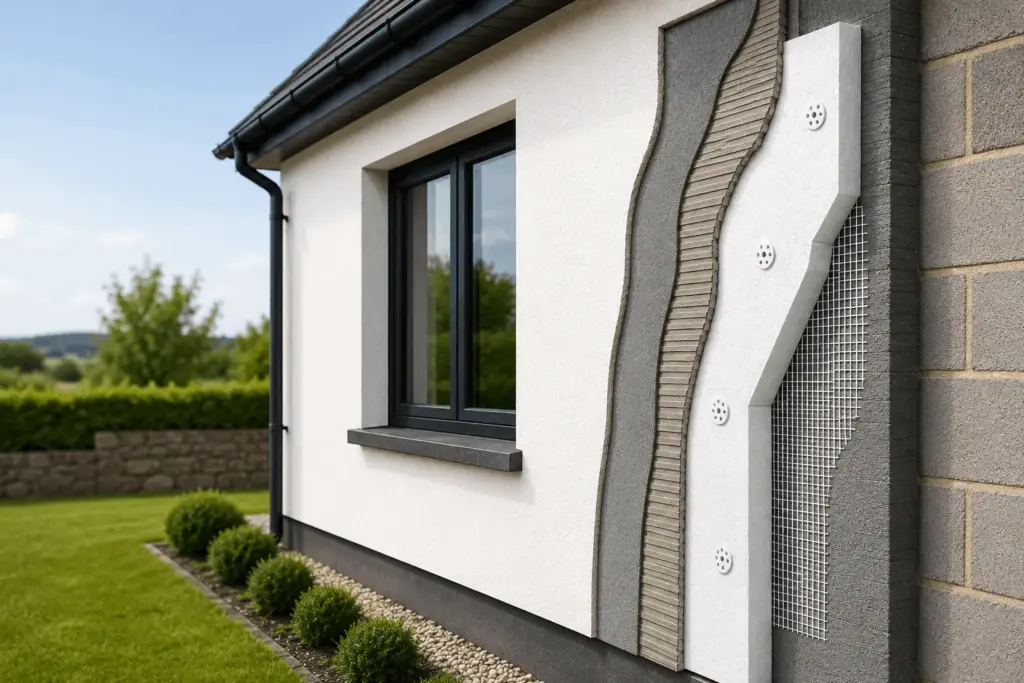
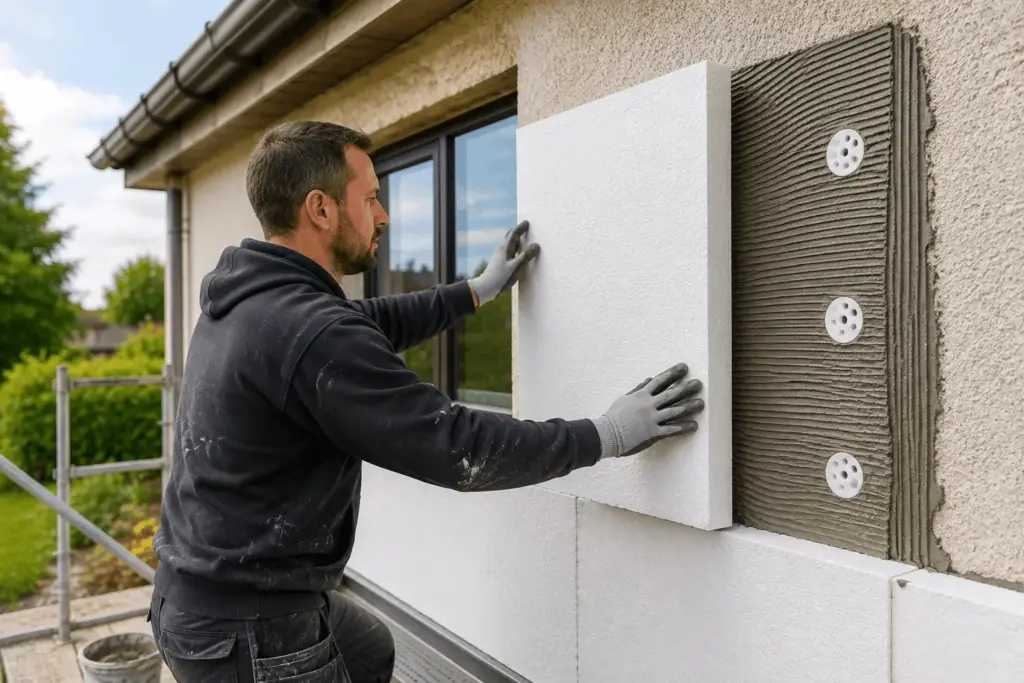
This is a bigger job than cavity wall or internal insulation. You’re adding a full external layer to your home: insulation boards, mesh reinforcement, and a new render or cladding finish. Scaffolding goes up around the entire building, and the work usually takes one to two weeks, depending on the weather and house size.
Quotes vary a lot between contractors. Two companies can look at the same house and come back with prices €4,000 apart, mostly down to the render finish chosen and how much wall repair work is needed underneath.
Average External Wall Insulation Costs
Before grants are applied, here’s what you can expect to pay based on property type.
| Property Type | Typical Cost Range |
|---|---|
| Terraced house | €9,000 – €12,000 |
| Semi-detached house | €11,000 – €15,000 |
| Detached house | €15,000 – €20,000 |
| Bungalow | €12,000 – €17,000 |
These figures cover supply and installation of insulation boards, mesh, render, and scaffolding hire. They don’t include extras like window reveal extensions, rainwater goods adjustments, or significant wall repairs, which can add to the final bill.
The cost of external wall insulation in Ireland is driven mainly by wall surface area. A bungalow has more roof-to-wall ratio and often a larger footprint than a two-storey house of the same floor area, which is why bungalow costs can creep close to detached house pricing even with a smaller internal layout.
If you’re weighing this up alongside other improvements, it’s worth reading about the Cost of Building a House in Ireland for a wider sense of where insulation fits into your overall renovation budget.
External Wall Insulation Cost by House Type
Property type is the single biggest factor in your final quote. More external wall area means more insulation board, more render, and more scaffolding to cover. A detached house has walls on all four sides exposed to the elements, while a mid-terrace house might only need two walls insulated. This is also exactly how SEAI structures its grant amounts, so understanding your house type helps you budget accurately from the start.
Terraced House
Terraced houses are the most affordable to insulate externally, usually costing €9,000 to €12,000. With shared walls on one or both sides, there’s less exposed surface area to cover. Scaffolding requirements are also smaller, which keeps labour costs down compared to detached properties.
Semi-Detached House
External wall insulation cost for a semi detached house in Ireland typically lands between €11,000 and €15,000. With one shared wall and three exposed walls, semi-detached homes need more material and scaffolding than terraced houses but less than fully detached properties. This is the most common house type in Irish suburbs, so most contractors quote this job regularly.
Detached House
External wall insulation cost for a detached house is the highest of all property types, generally ranging from €15,000 to €20,000. All four walls are exposed, scaffolding wraps the entire building, and larger floor areas mean more square metres of insulation board and render. Detached homes also qualify for the highest SEAI grant, which helps offset the bigger spend.
Bungalow
Bungalows often cost €12,000 to €17,000 to insulate externally. Single-storey homes have a higher wall-to-floor ratio than two-storey houses, so even a modest bungalow can need more wall coverage than expected. Roof eaves and window positioning can also add complexity to the render detailing.
Apartments and Other Property Types
Apartments are less commonly insulated externally on an individual basis, since walls are often shared and any work usually needs to be agreed at a building or management company level. Where it does apply, costs are typically lower per unit, and SEAI offers a separate grant rate for apartments.
External Wall Insulation Cost Per Square Metre
Many contractors price external wall insulation cost per m2 of wall area rather than by house type alone, especially for larger or non-standard properties. This gives a more precise figure once a surveyor has measured your actual wall surface.
100m² House
A smaller home around 100m² of floor area typically has 90 to 110m² of external wall surface to insulate, costing roughly €9,000 to €11,000 in total.
150m² House
A mid-sized 150m² house usually needs 130 to 160m² of wall coverage, bringing the typical cost to between €12,000 and €15,000.
200m² House
Larger homes around 200m² often have 180 to 220m² of exposed wall area, pushing total costs to €16,000 to €20,000 or more.
| Property Size | Approximate Cost |
|---|---|
| 100m² | €9,000 – €11,000 |
| 150m² | €12,000 – €15,000 |
| 200m² | €16,000 – €20,000+ |
Per square metre, most Irish contractors charge somewhere between €100 and €130, though this varies with render type, insulation thickness, and regional labour rates.
SEAI Grants for External Wall Insulation
SEAI offers a fixed grant toward external wall insulation, and the amount depends on your dwelling type rather than the actual cost of your job. These are flat grants, not percentages, so the same amount applies whether your contractor quotes you €12,000 or €16,000 for a given house type.
Available SEAI Grant Amounts
As of 2026, SEAI’s external wall insulation grant is €8,000 for a detached house, €6,000 for a semi-detached or end-of-terrace house, and €3,500 for a mid-terrace house. Apartments qualify for €3,000. These are the maximum fixed amounts and don’t vary by your specific contractor quote.
Eligibility Requirements
Your home must have been built and occupied before the end of 2010 to qualify. All external walls must be insulated as a complete, whole-surface solution rather than partially, and the work must be carried out by an SEAI-registered contractor. You’ll need grant approval in writing before any work begins, and a post-works BER assessment is required to draw down the payment.
Actual Cost After Grants
Once the grant is deducted, most homeowners pay between €5,000 and €13,000 out of pocket, depending on house type and the size of the job. Detached houses see the biggest absolute saving, though semi-detached homes often see the best value relative to total project cost.
| Property Type | Typical Cost | Available Grant | Estimated Cost After Grant |
|---|---|---|---|
| Terraced house | €9,000 – €12,000 | €3,500 | €5,500 – €8,500 |
| Semi-detached house | €11,000 – €15,000 | €6,000 | €5,000 – €9,000 |
| Detached house | €15,000 – €20,000 | €8,000 | €7,000 – €12,000 |
| Bungalow | €12,000 – €17,000 | €6,000 – €8,000* | €4,000 – €11,000 |
*Bungalow grant amount depends on whether the property is classified as detached or semi-detached by SEAI.
Full eligibility details and the official application process are available directly through SEAI, who administer all home energy grants in Ireland.
If you’re also looking at other upgrades around the same time, it’s worth planning the work alongside any Home Renovations Leitrim project, since scaffolding and access can often be shared across multiple jobs to save on costs.
What Affects External Wall Insulation Costs?
No two quotes look the same, even for similar-sized homes. Several practical factors determine where your final price lands within the typical ranges.
Property Size and Wall Area
The more wall surface your home has, the more insulation board, mesh, and render your contractor needs to buy and install. This is the single biggest driver of cost and the reason house type correlates so closely with price.
Existing Wall Condition
Cracked render, damp patches, or unstable pointing need to be addressed before insulation goes up. Older solid-wall homes, particularly those built before the 1940s, sometimes need more preparatory work than newer builds.
Insulation Thickness
Thicker insulation boards cost more upfront but deliver better thermal performance and lower long-term heating bills. Most Irish installers use boards between 100mm and 150mm, with thickness chosen based on your wall type and target BER rating.
Scaffolding Requirements
Scaffolding is priced by the square metre of building perimeter and by how long it stays up. Taller homes, complex rooflines, and tight site access can all push scaffolding costs higher.
Labour Costs
Skilled, SEAI-registered installers charge according to experience and regional demand. Dublin and other high-demand areas can see slightly higher labour rates than rural counties, though material costs stay broadly consistent nationwide.
External Wall Insulation vs Internal Wall Insulation
Both external and internal wall insulation reduce heat loss through solid walls, but they work differently and suit different situations. The right choice often comes down to your budget, how much disruption you can tolerate, and whether you’re also due an external refresh like new render.
Benefits of External Insulation
External insulation wraps your entire home in a continuous thermal layer, which eliminates cold bridging far more effectively than internal systems. There’s no loss of internal floor space, no need to move furniture or decorate rooms afterwards, and your home gets a complete render refresh as part of the job. It also protects the existing wall structure from weather damage going forward.
Benefits of Internal Insulation
Internal insulation is considerably cheaper and faster to install, and it doesn’t require scaffolding or planning considerations around your home’s external appearance. It’s a practical option if you’re only insulating a few rooms or if external work isn’t feasible due to listed building status or terrace restrictions.
Which Option Offers Better Value?
External insulation costs more upfront but delivers stronger long-term performance and adds genuine kerb appeal. Internal insulation suits tighter budgets or partial upgrades.
| Feature | External Insulation | Internal Insulation |
|---|---|---|
| Typical cost | €9,000 – €20,000 | €4,000 – €9,000 |
| SEAI grant (detached) | €8,000 | €4,500 |
| Disruption to living space | None | Moderate to high |
| Internal floor space lost | None | Yes, slightly reduced |
| Cold bridging performance | Excellent | Good |
| Exterior appearance | Refreshed/improved | Unchanged |
| Suitable for terraced homes | Yes, with neighbour consideration | Yes |
How Much Money Can External Wall Insulation Save?
Reducing heat loss through your walls means your heating system works less hard to keep your home at a comfortable temperature. For many homeowners, the long-term savings are just as important as the grant itself when deciding whether the project makes sense.
Annual Energy Savings
Solid walls without any insulation can account for around a third of total heat loss in an older Irish home. Once external insulation is fitted, many homeowners see a meaningful drop in the energy needed to heat their property, particularly in homes that previously had no wall insulation at all.
Heating Bill Reduction
Actual savings depend on your current heating system, how well-sealed the rest of your home is, and your usage patterns, but reduced heat loss through the walls translates directly into lower heating bills year after year, especially during the winter months when heating costs are highest.
Estimated Payback Period
Payback periods vary by house type and post-grant cost, but for many homeowners the investment pays for itself over a number of years through reduced heating bills, while also delivering an improved BER rating and added comfort from day one.
| Property Type | Estimated Annual Savings | Estimated Payback Period |
|---|---|---|
| Terraced house | €250 – €400 | 14 – 22 years |
| Semi-detached house | €300 – €500 | 12 – 18 years |
| Detached house | €400 – €650 | 12 – 19 years |
| Bungalow | €350 – €550 | 10 – 17 years |
These figures are estimates and will vary based on your current heating system, occupancy patterns, and energy prices. A post-works BER assessment will give you a clearer picture specific to your home.
Is External Wall Insulation Worth It?
For homes with solid, uninsulated walls, external insulation is usually worth the investment when you factor in the SEAI grant, ongoing energy savings, and the boost to your BER rating and property value.
Key Benefits
Beyond lower heating bills, external insulation improves comfort by eliminating cold spots and draughts near walls. It also refreshes your home’s exterior appearance, protects the building fabric from weather damage, and can meaningfully improve your BER rating, which matters increasingly to buyers.
Potential Drawbacks
The upfront cost remains significant even after grants, and the work does involve scaffolding and a period of disruption outside your home. Window reveals and door surrounds sometimes need extending to accommodate the added wall thickness, which can add to the final bill.
Common Mistakes to Avoid
A few recurring mistakes cost Irish homeowners money or leave them with a poor result.
Choosing Based on Price Alone
The cheapest quote often skips wall preparation or uses thinner insulation. Compare what’s actually included before deciding.
Ignoring Grant Eligibility
Starting work before grant approval means you forfeit the SEAI payment entirely. Always confirm approval first.
Hiring Unqualified Installers
Only SEAI-registered contractors qualify for grant-aided work, and poor installation can cause damp issues later.
Skipping Necessary Wall Repairs
Insulating over cracked or damp walls traps problems rather than solving them. Address structural issues first.
Frequently Asked Questions
How much does external wall insulation cost in Ireland?
External wall insulation cost in Ireland typically ranges from €9,000 to €20,000 before grants, depending on house size and type. Terraced houses sit at the lower end, while larger detached homes cost more due to greater wall surface area.
Is external wall insulation worth it?
For most homes with solid, uninsulated walls, yes. The SEAI grant reduces upfront cost significantly, and the energy savings, improved comfort, and better BER rating add long-term value beyond the initial spend.
What SEAI grant is available?
SEAI offers up to €8,000 for a detached house, €6,000 for semi-detached or end-of-terrace, and €3,500 for mid-terrace properties. Apartments qualify for €3,000. Eligibility depends on your home being built before 2011.
How much can I save on heating bills?
Savings vary by house type and current heating efficiency, but many homeowners see meaningful annual reductions once solid walls are properly insulated, particularly if no wall insulation existed previously.
How long does external wall insulation last?
Properly installed external wall insulation systems typically last 30 to 50 years with minimal maintenance, though render may need occasional cleaning or minor repair over that lifespan.
Does external wall insulation increase property value?
A better BER rating and refreshed exterior appearance both tend to support property value, particularly as energy efficiency becomes a bigger factor for Irish home buyers.
Is external insulation better than internal insulation?
External insulation generally performs better thermally and avoids any loss of internal floor space, but it costs more upfront. Internal insulation suits smaller budgets or partial room upgrades.
Conclusion
External wall insulation cost in Ireland typically falls between €9,000 and €20,000, depending on your house type and size, with SEAI grants of up to €8,000 bringing the net cost down considerably. For homes with solid, uninsulated walls, the combination of grant support, lower heating bills, and improved comfort makes a strong case for the investment.
If you’re planning external wall insulation alongside other improvements, projects like House Extensions Leitrim or addressing your Roof Repair Leitrim needs first can help you get the most value from shared scaffolding and a more complete upgrade to your home’s overall energy performance. And if you’re still deciding on materials for your wider renovation, our guide to the Best Roofing Material covers how roof choice affects your home’s overall thermal efficiency, too.
The All Task Roofing & Building team specialises in roofing, roof repairs, new roof installations, flat roofing, chimney repairs, gutters, fascia & soffits, house extensions, and property renovations. With years of hands-on industry experience, our team shares expert insights, practical advice, and trusted guidance to help property owners make informed decisions about maintaining and improving their homes and buildings.